


Response within 24h.
From a failed inspection to a safe, compliant and professionally documented installation
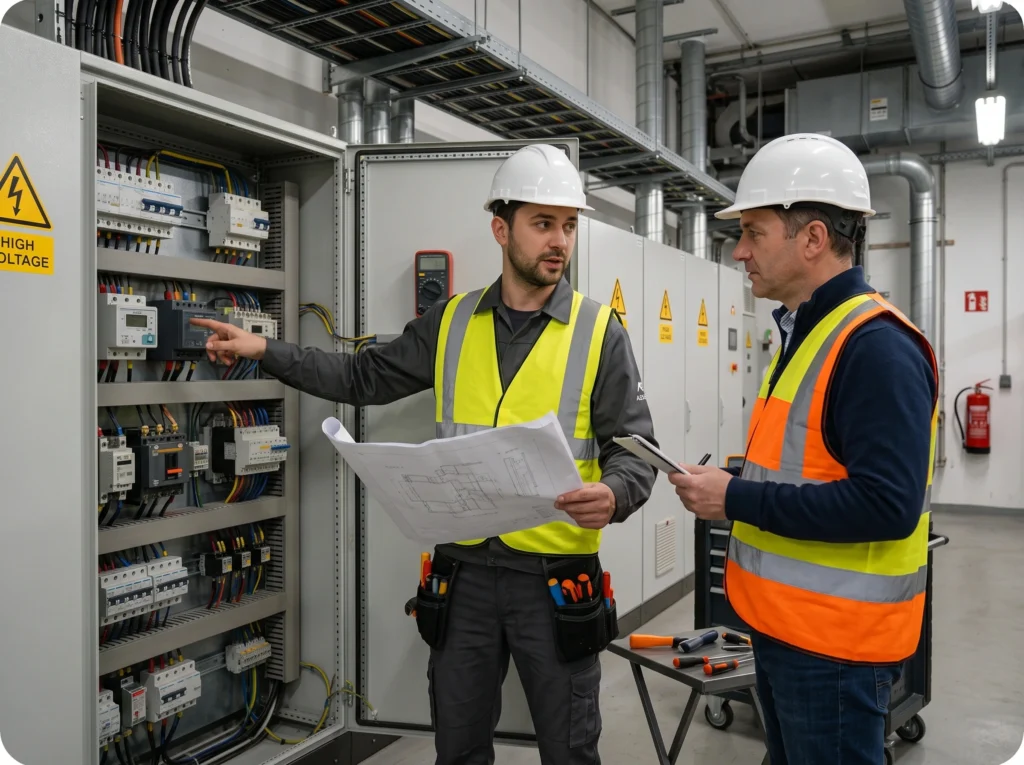
A failed electrical inspection in an office, commercial premises, warehouse, business building or other professional setting calls for a different approach from a typical home. The installation is usually more extensive, business continuity is a key consideration, and all modifications require proper technical, practical and administrative follow-up.
As Built manages the entire process: analysing the inspection report, conducting a technical site survey where necessary, carrying out the remedial works, preparing or updating the electrical diagrams, and following up on the reinspection.
We work with owners, building managers, co-ownership property managers, facility managers, investors and businesses with non-residential electrical installations.
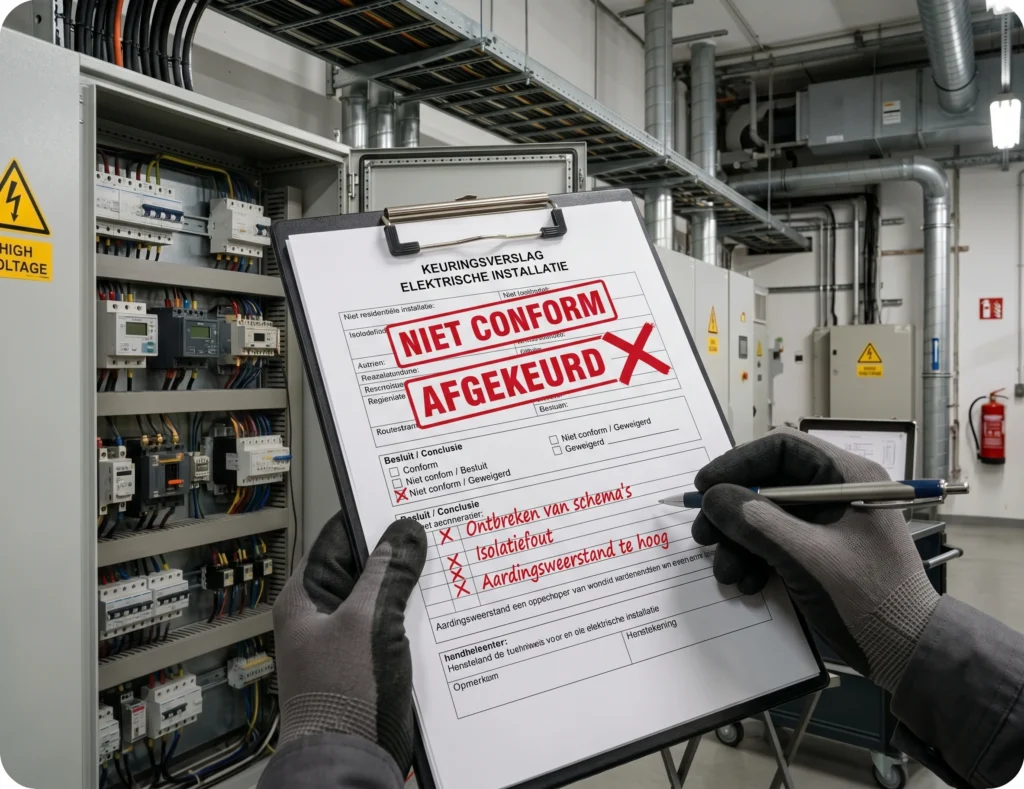
Request a free quote
Fill in the quote form and briefly tell us what needs to be done.
Prompt follow-up (within 24 hours)
We will contact you within 24 hours. You will receive an initial estimate.
Site visit and final planning
The site manager discusses the details and price, then we schedule the work.
Execution
We carry out the work through an As Built certified partner in your area.
Compliant installation
Safe and compliant installation with clear communication and fair pricing.
FAQ
As Built guides you through bringing your electrical installation into compliance, from reviewing the
inspection report and arranging a technical site visit where needed to carrying out the works, preparing
the electrical documentation and coordinating the reinspection. No inspection report yet? Where
necessary, we first arrange an inspection by an approved inspection body. You have one point of
contact throughout the process.
Our services cover offices, shops, hospitality premises, warehouses, workshops, commercial and
industrial buildings, and communal installations in apartment buildings. We assess the purpose, layout
and use of each installation. This FAQ focuses mainly on low-voltage installations. We take a separate
approach to compliance works and maintenance for high-voltage substations.
Yes. Your installation must meet the requirements that apply to it. For low-voltage installations, the
main reference is Belgium’s General Regulations on Electrical Installations, known as AREI in Dutch
and RGIE in French. Workplaces are also subject to requirements under the Belgian Code on Well-
being at Work. The works needed depend on the installation, its operating conditions and any
applicable exceptions.
Send us the complete inspection report. We turn the identified non-conformities into a practical scope
of works and assess whether a site visit is needed. You then receive a clear quotation. Once you
approve it, we schedule and carry out the adjustments, update the agreed documentation and
organise the reinspection. Any urgent safety measures take priority.
Non-conformities identified during a periodic inspection must be corrected without delay. If the
installation remains in use, appropriate measures must prevent those non-conformities from creating a
hazard. A new installation, or a part that has failed its pre-commissioning inspection, must not be put
into service. We help you identify the urgent works and agree a schedule that takes safety into
account.
Most fixed, non-domestic low-voltage installations require a periodic inspection every five years.
Annual inspections apply to categories including temporary, mobile or transportable installations and
installations in areas with an explosion risk. New installations and significant alterations or extensions
also generally require an inspection before being put into service. We check which inspections and
deadlines apply to your installation.
Not necessarily. We identify which components can remain and which adjustments are needed to
correct the reported non-conformities. This may involve targeted corrections to a distribution board or
more extensive work on wiring and protective devices. Existing components are assessed against the
requirements that apply to them. We propose an approach tailored to your installation, rather than a
standard full refurbishment.
Depending on the inspection report, we can adapt distribution boards, protective devices, wiring,
connections, earthing and equipotential bonding. Circuit identification and protection against access to
electrical parts may also form part of the works. The quotation sets out the proposed interventions, so
you know in advance what we will carry out and what is included in our scope.
Yes. We can survey the installation on site and prepare or update the agreed diagrams and plans.
Depending on your installation, the file may include circuit diagrams, layout plans, earthing information
and documents covering external influences. Additional documentation may be needed, for example
for safety installations or areas with an explosion risk. We establish in advance what is missing and
what our scope includes.
No. A report confirming compliance does not replace the risk assessment and preventive measures
required for electrical installations in workplaces. Safe operation, maintenance, instructions and staff
competence also need ongoing attention. As Built can handle the technical compliance works and
related documentation. Coordinate any additional obligations with your prevention adviser so that the
inspection forms part of a wider safety policy.
A significant alteration or extension generally requires a compliance inspection before it is put into
service. One example is replacing a distribution board with a non-identical board. Additional
machinery, charging points or solar panels may also affect the existing installation. We assess the
impact and coordinate the required inspection. Minor alterations require updated diagrams and
documentation, but not a separate inspection before use.
The price depends on the reported non-conformities, the size and accessibility of the installation, and
the materials and documentation required. Organising any power shutdowns also affects the scope.
We prepare a clear quotation based on your inspection report and, where needed, a site visit. It
specifies which works, documents and inspections are included. Any additional works are discussed
before they are carried out.
This depends on the number of non-conformities, the technical complexity, material availability and
when we can work safely. Minor adjustments require a different schedule from modifying several
distribution boards. After assessing the installation, we agree a realistic programme. This takes
account of both the works and the inspection body’s availability for the reinspection.
Not always. We assess whether the works can be completed by area or in phases and agree any
power shutdowns with you in advance. Together, we identify the impact on systems such as
production, refrigeration, IT and access control. A shutdown is necessary for work that must be carried
out with the supply isolated. Safety remains the deciding factor in how the works are organised.
The official inspection is carried out by an approved inspection body, which also issues the inspection
report. As Built prepares the installation, carries out the agreed compliance works, and organises and
supports the reinspection. You do not have to coordinate the different parties yourself. The final
assessment of compliance is made independently by the inspection body.
Yes. We can review the inspection reports, required works and schedule for each building and
coordinate them with you. This is useful for property managers, managers of co-owned buildings and
businesses with multiple locations. We can work alongside your technical team, facility manager or
existing electrical contractor. Responsibilities, access, documentation and follow-up arrangements are
agreed in advance.
You receive the report from the approved inspection body, together with the diagrams and documents
we have prepared or updated within the agreed scope. If the installation is found to comply, the
inspection report confirms this. Any outstanding non-conformities are discussed and included in the
follow-up. You therefore have a clear view of the outcome and the documents you need to retain.
Send us your complete inspection report, the building address and your contact details. Include any
available diagrams and photographs of the distribution boards, and let us know your preferred
deadlines and any restrictions on power shutdowns. No report yet? We will assess whether an
inspection or technical site visit should be arranged first. You then receive a clear, no-obligation
quotation for the agreed scope.